Write your template once
Set up the agreement in a rich-text editor with your headings, tables, wording and logo. If you prefer working with the underlying markup, switch to the HTML source view and edit it directly.
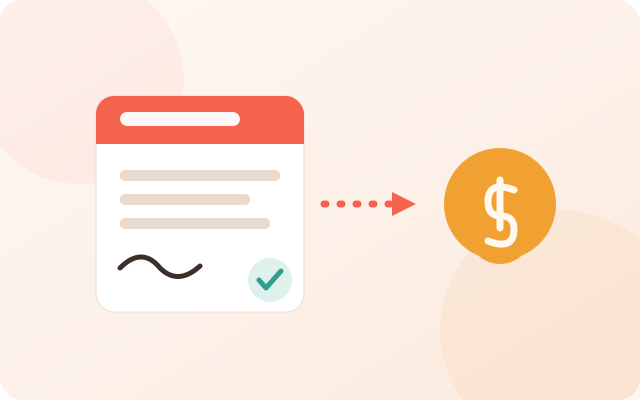
Write your agreement once, in your words and with your logo. Every client agreement then fills itself with their details, plan manager, dates and funded supports, ready to preview, publish and send for signature.
Short demonstrations in the real product, using made-up data. Choose a part to watch it here.
Watch the full series on YouTube (opens YouTube in a new tab)
Write your agreement your way, with rich text, HTML control, and your own logo.
Client, plan-manager, dates and line items fill themselves in, so you never retype them.
Update the template freely; agreements already signed stay exactly as signed.
Most providers still build service agreements by copying the last client's document and hand-editing names, dates, supports and prices. It is slow, it invites mistakes, and one stale detail is enough to put the wrong supports in a signed document. And when the wording changes, nobody is quite sure which version each client actually agreed to.
Set up the agreement in a rich-text editor with your headings, tables, wording and logo. If you prefer working with the underlying markup, switch to the HTML source view and edit it directly.
Insert placeholders for the client's name, NDIS number, plan manager, agreement dates, your provider details and more. Special placeholders position the funded-supports table and the signature block wherever they sit in your document.
Preview the template filled with sample data, save drafts as you go, and publish when you are happy. Publishing creates a numbered version, and only published versions are used for new agreements.
Every agreement fills itself with that client's details, plan manager, dates and funded supports, complete with quantities and budgets. Review the PDF before it goes anywhere.
Send the agreement for E-signature in one step. The exact document is captured at that moment, so later template edits never change what a client was asked to sign.
A rich-text editor with headings, lists, tables and emphasis, plus an HTML source view and your organisation's logo. The agreement reads as your document, not a generic one.
Client, representative, plan manager, funding management type, agreement number and dates, provider name, ABN and address, budget totals and more fill themselves in for each client.
Place the line-item table once and every agreement renders that client's supports, codes, unit prices, quantities and budgets. You never hand-build a pricing table.
Paste the agreement you already use into the editor and BondiByte finds the wording that should become a template variable, keeping your wording and structure. You confirm each suggestion, choose a different variable where it got one wrong, or keep your wording as it is, and nothing changes until you apply them.
Drafts stay private until you publish, each publish creates a numbered version, and you can restore the built-in starting template at any time.
See exactly how the finished document will look, filled with sample data, before you publish or generate anything for a real client.
Draft edits sit safely alongside the live template. New agreements only ever use the version you deliberately published.
Every signed agreement keeps the exact document that was signed. Updating the template later never rewrites history.
You see the generated PDF for each client and choose when it goes out for signature.
BondiByte provides the document builder and a starting template, not legal advice. Review the wording with your own advisers before you rely on it.
Yes. Paste your current agreement into the editor and BondiByte finds the wording that should become template variables. You confirm each one, swap any it got wrong, and preview the result with sample data before anything is saved. Finding variables is one of the AI-assisted features, so it is available once your organisation has turned those on. Placing variables yourself from the editor always works.
More than 30 details, including the client's name, NDIS number and contact details, their representative, the plan manager, agreement number and dates, funding management type, your provider details and logo, the funded-supports table and the budget total.
Nothing. Signed agreements are captured as fixed copies at signing time. Template changes only affect agreements generated after you publish the new version.
No. You place the line-item table once in the template. Each agreement then shows that client's funded supports with codes, unit prices, quantities and budgets automatically.
No. It is a practical starting point. Review the wording with your own team or advisers before relying on it, the same way you would any agreement.
From a configurable template with auto-filled details and funded-supports line items to a signed, locked PDF, in one flow.
Agreements & BillingSend agreements and contracts for E-signature straight from the record. Clients and staff sign on any device without an account, and the exact document they signed is stored, timestamped and locked.
Agreements & BillingEvery funded support sits on the agreement as a line item: the NDIS code, unit price, quantity and budget, entered once. Shifts, invoices and claims all draw from those same lines.
Agreements & BillingShifts become draft timesheets carrying pay levels and sleepover components, ready for approval and payroll.
Agreements & BillingShift billing line items flow into draft invoices, with PDFs, invoice email and your payment details.
Agreements & BillingCatalogue item numbers on every agreement and billing lines on every delivered shift feed your invoices, and coordination time is claimed in batches into a claim file (CSV) per participant. When it is time to prepare your NDIS claims, the numbers are already there and they trace back to delivered support.
Start your free trial, or book a demo to see it with your own operation in mind.
Hi, I can help with BondiByte features, pricing, setup and more.
Please don’t include sensitive participant or personal information.